
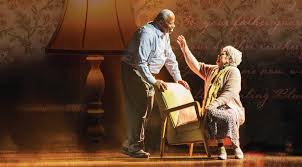
New Zealand Opera’s Bluebeard’s Castle is a one-act opera composed by Béla Bartók with a libretto by Béla Balázs that has been reworked by Director Daisy Evans.
Instead of a dark and forbidding castle, Bluebeard (Lester Lynch) and Judith (Susan Bullock) are an elderly couple living alone in the modern era and coming to terms with Judith’s struggle with dementia. The infamous doors in the original are replaced by a locked packing case.
This opera is allegorical with the castle representing the human psyche, an inner world filled with desire and doubt. Judith is desperate to remember the past and in doing so we see glimpses of her own insecurities, jealousy, and even her meddlesome obsession with having to know everything and always needing to be being right.
She repeatedly demands to look inside the case. Bluebeard reluctantly agrees despite his worry about how his wife will react. The case is filled with artefacts and memories and at each opening some part of the past is lovingly explored – the couple’s wedding day, the birth of their children, a happy Christmas gathering.
While Judith is initially pleased, every memory turns to darkness and she sees blood everywhere, a reminder that life is complex and also filled with grief. A pair of baby bootees brings joy, but memories of their dead son are overwhelming.
In reliving her past, present day Judith claims to be nothing compared to those past selves. The blood she sees is, perhaps, her own anger and frustration.
Bluebeard however has a different perspective. He has loved Judith since he met her. She is his morning, his noon, his evening and his night. Among his final words to her are these: ‘You’re my all and always will be – eternal beauty.’
He hands her a mirror, the final ‘door’ which he warns will show her the truth. But what does she see? The subjective and negative view of herself or the Judith that Bluebeard has always known and loved?
The production was staged as a concert opera in the Auckland Town Hall with a minimal set and the orchestra on stage with the vocalists.
Bullock played the vulnerability, confusion and feistiness of Judith convincingly and her beautiful voice captured every nuance of the role perfectly. Lynch brought a strong yet loving persona forth for Bluebeard and also touch of vulnerability which was great to see and his rich and powerful bass baritone gave a grandeur to the role.
It is always a treat to witness the artistry and precision of the Auckland Philharmonia who brought life and passion to the intricate mix of styles that constitutes Bartók’s score.
The music in this opera jumps about – sometimes brooding and menacing, other times light and frothy. There is a scene when Bluebeard and Judith sing of this mighty kingdom they inhabit and the orchestra produced the most intense and triumphant anthem. Riveting stuff!
It may seem odd to choose dementia as the theme of this reimagining but it’s actually very clever and perfectly suited to the symbolism of the libretto. The original is about carnage and tragedy, the loss of life and the imprisoning of the self. What better metaphor for the decline that can come with ageing.
Yet to dwell on the negative aspect of that would be a shame. The story ends with Judith alone in a chair. It is a poignant moment but certainly not depressing. In looking back Judith can see a lifetime of experiences, some good and some bad, but also a life filled with love.
Yet a question remains. Nearing the end of her life, has she truly understood this journey she’s been on? Or does she still doubt herself and her place?
What a satisfying end to an opera.
BLUEBEARD’S CASTLE
13 & 14 March 2026
Auckland Town Hall – Auckland